
Commerce City Previous Resident Sources
There is no single Commerce City resident history file. A reliable search starts with the current parcel, then uses the source that matches the question and the era. Deeds track recorded parties, directories track printed occupants, permits date construction activity, and census or obituary records add household context. Each source has a different custodian and a different gap.
| Source | Years It Covers | Where Held | What It Shows |
|---|---|---|---|
| Adams Landmark deed index | Current online records; start and cutoff not displayed | Adams County Clerk & Recorder | Grantor/grantee, document type, dates, legal description, and images; no tract index |
| County deed books and microfilm | Pre-digital historical series; exact cutoff not displayed | Recording counter and archives | Earlier instruments, legal descriptions, and signatures |
| Adams Assessor and GIS | Current data; historical cutoff not located | Adams County portals | Parcel, account, owner, situs, and possible mailing clues |
| Commerce City eTRAKiT | Current system from May 8, 2023; earliest year not located | City permit portal | Permits, APN, lot/block, inspections, reviews, conditions, and project dates |
| DPL local directories | 1949, 1962, 1969-1976 | Denver Public Library | Names by address, household clues, business context, and phone sections |
| Federal census | Public images follow the 72-year release rule | NARA, FamilySearch, and library databases | Household and neighborhood clues by enumeration district |
| Rose Hill Cemetery | Founded 1892; current locator | Cemetery and FamilySearch | Plot and interment clues, not a residence or certificate record |
For a recent house, begin with the assessor or permit record and then move to the recorder. For an older address, preserve the legal description and printed locality before requesting deed books, directories, or archive series. The best source is the one that answers the narrow question without pretending to show more than its fields contain.
Commerce City Address Records First
A current parcel gives previous-resident research an anchor. The Commerce City eTRAKiT sample `SFD231012` is a useful schema example: a closed Residential New Construction permit applied January 23, 2023, issued February 7, 2023, and finaled August 21, 2023. Its site card shows 12352 E. 101st Place, Commerce City, APN `172113209004`, Turnberry Filing 6, Block 3, Lot 17, and related records. The sample is a record shape, not proof that a permit applicant owned or lived at the address.
| Permit | SFD231012, closed residential new construction |
|---|---|
| Address and APN | 12352 E. 101st Place, Commerce City; 172113209004 |
| Subdivision | Turnberry Filing 6, Block 3, Lot 17 |
| Related records | RMSTR23-00003, CO23-00187, and MSC231012 |
| Visible tabs | 49 inspections, 11 conditions, 3 reviews, plus contacts, project, area, and attachment tabs |
The eTRAKiT public permit search can be searched by address, parcel ID, permit number, owner or applicant name, status, and ZIP Code. Record the APN and lot/block before opening a deed search. A permit dates work on a parcel; it does not replace a title record or identify every former household.
Trace Commerce City Deeds Backward
The Adams County recorder is grantor/grantee indexed, not tract indexed. That means a street or parcel number alone is not enough for the historical deed chain. Use the assessor or GIS to identify the recorded owner and legal description, then walk backward from the current grantee to the prior grantor.
- Pull the current owner, parcel or account number, situs address, and legal description from the assessor or GIS.
- Search the owner in Adams Landmark Web as a grantee and identify the purchase instrument.
- Record the reception number, recording date, document type, book/page or image, grantor, and legal description.
- Search that grantor as a grantee, then repeat the same step through earlier instruments.
- When the online trail stops, ask the recorder counter, deed books, microfilm, State Archives, or a records request for the earlier legal description.
- Grantor and grantee
- The grantor transfers an interest; the grantee receives the recorded interest.
- Chain of title
- A sequence of recorded transfers linking one interest to an earlier one.
- Legal description
- The parcel identity used in an instrument, often more stable than an old street string.
The Adams County Recording Department accepts walk-ins, mail, FedEx or UPS, e-recording vendors, and public online searches. Recording hours are Monday, Tuesday, Thursday, and Friday 8 a.m. to 4:30 p.m.; Wednesday 8:30 a.m. to 4:30 p.m. The current recording charge is $43 per document from July 1, 2025 under C.R.S. §30-1-103. Regular copies are $0.25 per page; certified copies add $1 per document. Uncertified online images are free, while certified copies are requested by phone at 720-523-6020 or in person.
Landmark Grantor Records for Commerce City
Landmark's name search gives a repeatable way to test a prior owner. The party control offers Both, Grantor, or Grantee. Name is required in last-name-first order, with Starts With, Contains, Equals, and Sounds Like match choices. Book Type, Document Type, Document Category, and begin and end dates narrow the result. The online cutoff is not displayed on the county pages, so a clean no-hit cannot establish that an older deed never existed.
| Landmark field | Use in a previous-resident search |
|---|---|
| Party Type | Test the owner as Grantee, then the seller as Grantor or Grantee. |
| Name and match type | Use last name first; compare Starts With, Contains, Equals, or Sounds Like. |
| Book and document controls | Narrow to Real Estate, Deeds, maps, liens, or another recorded category. |
| Begin and End Date | Separate a likely purchase window from a much older title search. |
| Result record | Reception or instrument number, date and time, parties, type, book/page or image, legal text, consideration, and view/print/download controls. |
The county's recording disclaimer matters: recording is not a legal opinion about validity or authenticity. A free image is an inspection copy, not automatically a certified copy. Adams also offers a free property-fraud alert that watches future recorded activity for a requested name. It is a notification service, not a historical deed database and not a substitute for tracing previous residents.
DPL House History for Commerce City
The DPL house-history guide points researchers toward reverse and criss-cross directories, telephone books, maps, assessor material, permits, and newspapers. It identifies Denver directories from 1866-1981 on microfilm, digitized coverage from 1873-1923, Polk volumes from 1899, 1913, and 1960-1996, and householder or criss-cross volumes in street order from 1924-2018, with 1924-1937 digitized. Sanborn coverage for the exact Commerce City address was not located, so a map should be checked for the parcel rather than assumed.
The guide is a fallback when the county's current web index does not reach the era needed. Use a printed street entry to identify the occupants, then compare a plat, deed book, permit card, newspaper, or archive series. A permit can date construction or an addition; it cannot prove that the applicant held title.
The DPL house-history guide is a practical bridge from a modern Commerce City address to the historical collections that can identify previous residents.
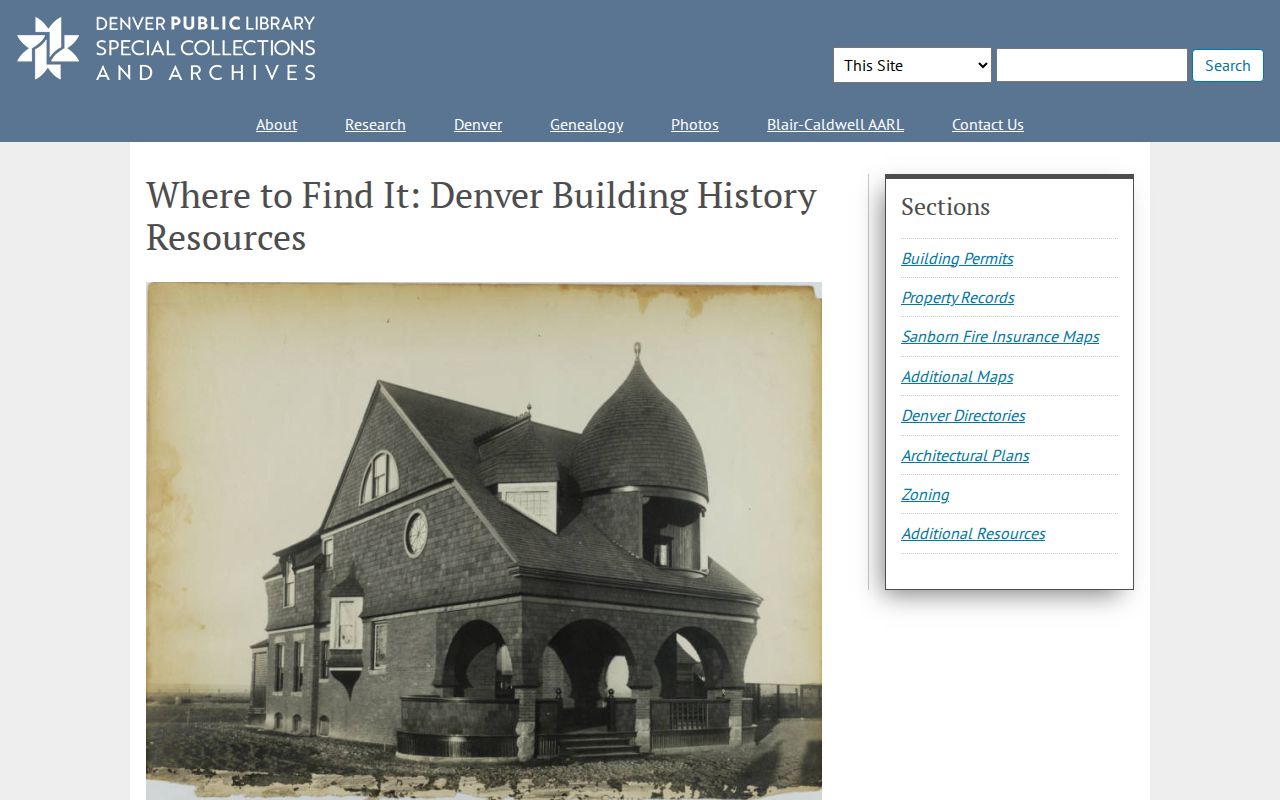
Its reverse-directory and map references help preserve the address trail when the same location appears under an older locality name.
Previous Residents in Commerce City Directories
The named local city directory run begins with the 1949 XL Adams County volume, continues through the 1962 South Adams County volume, and includes Polk Adams County/Commerce City volumes from 1969, 1970, 1971, 1975, and 1976. The 1949 book has people and trade listings without phone numbers. The South Adams volume includes Commerce City, Adams City, Derby, and contiguous areas. Polk adds city, street, classified, and numerical telephone sections.
The Commerce City city directory collections explain the publishers and shelves; for previous residents, the same volumes become a dated address layer. Copy the street exactly, record the page and section, then compare the same address in the nearest available volume. The DPL city-directory search guide notes that entries can include names, addresses, trade or role, spouse notation, death dates, partners, and forwarding or post-office notes.
The 1915 digitized Denver sample shows the format but did not yield an exact Commerce City entry. A directory absence can mean a move, a changed place label, an unlisted person, or a gap in local coverage. It is not proof that no one lived at the address.
The DPL city-directory search guide provides a second way to read a historical volume when an address-first trail needs a name or household clue.
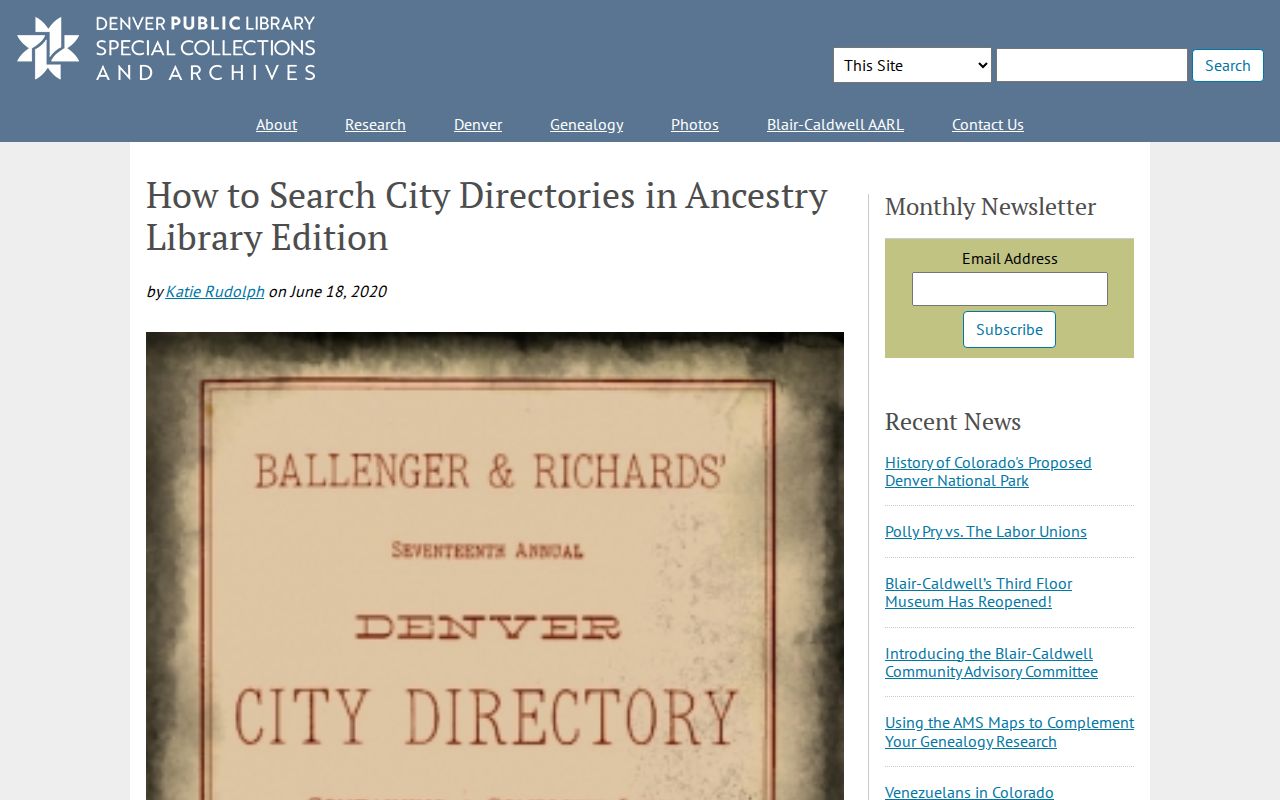
Use the abbreviation key and the printed street section before comparing an entry with a deed or census household.
Pairing Commerce City Census Records
For the household layer, use a simple sequence: printed address -> nearest available city directory -> nearest public census year -> enumeration district and neighboring households -> obituary, cemetery, or probate clue. Federal census images are released under a 72-year rule, so the latest public image set is intentionally behind the present. Directory years can fill the gaps between public census snapshots, but the place label and street form must be copied before they are modernized.
Compare a middle initial, spouse or household note, trade or role, address period, and nearby names. If the address falls near a former locality boundary, test Adams City, South Adams, Derby, Irondale, Commerce Town, and Commerce City. A census household and a deed party answer different questions, so keep occupancy, ownership, and interment as separate findings.
Rose Hill Commerce City Records
Rose Hill's plot locator accepts Last Name, First Name, Area, and Row. Results show Last Name, First Name, and Plot Location in Area-Row-Plot form, with map and print-PDF options. Rose Hill was founded August 25, 1892, is at 6841 E. 62nd Avenue, and is open Sunday through Friday from sunrise to sunset, closing on Shabbat and holidays.
A plot result can close a previous-resident trail when paired with a dated obituary or probate filing. It establishes a cemetery location, not a death certificate, legal residence, or exact date of departure from a house. FamilySearch reported 1,172 people on its Rose Hill site during the research pass, but an index hit still needs the cemetery result and an independent date source.
The Rose Hill plot locator gives a local name search with a distinctive Area-Row-Plot output, useful when a former resident is no longer present in a directory.
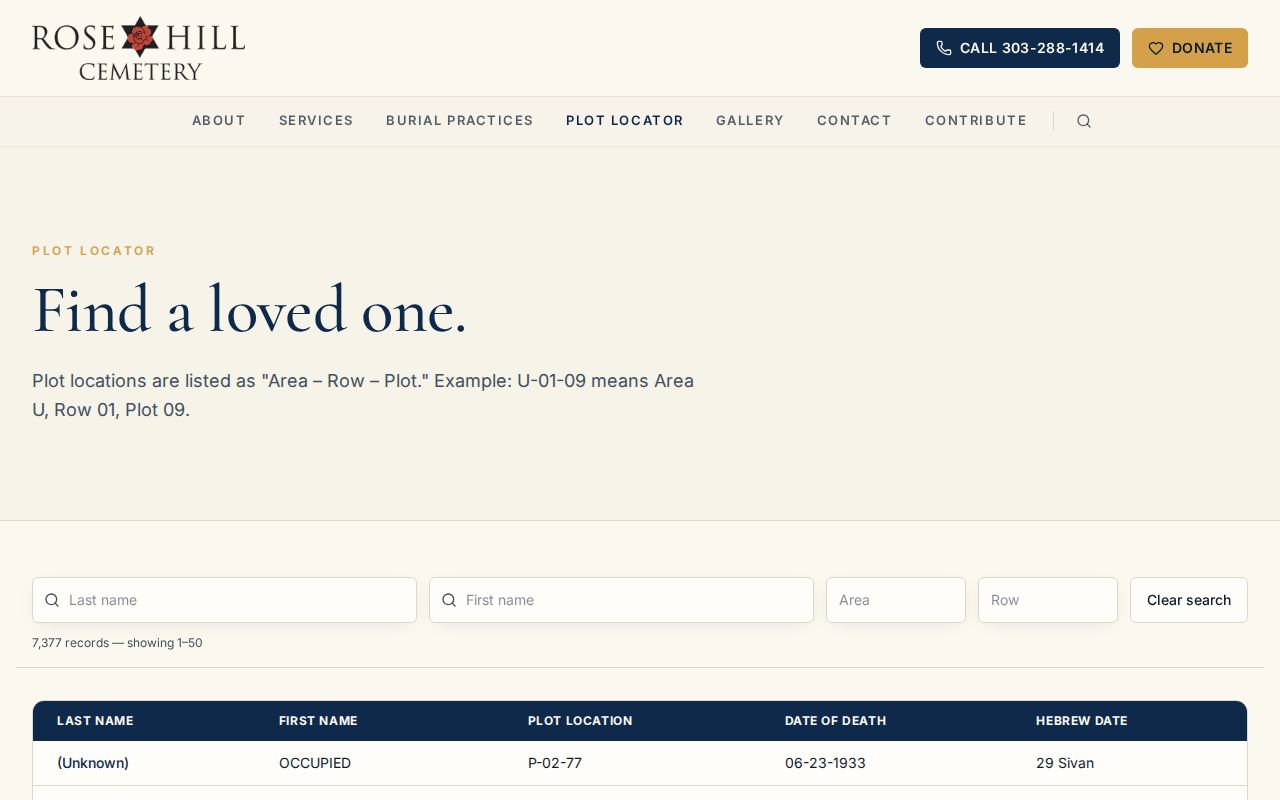
Keep the exact area and row with the result so another researcher can distinguish a cemetery clue from a public vital record.
Commerce City Address Records Change
Commerce City has a built-in locality crosswalk. Adams City was laid out in 1903 and vacated in 1922. Irondale dates to 1924. Commerce Town incorporated on July 8, 1952, Derby was annexed in 1962, and home rule arrived in 1970. The 1952 incorporation vote was recorded as 251 to 24. A deed, directory, census sheet, and newspaper can therefore use different place names for the same general area.
Test four keys together: the historical locality, the municipal boundary or annexation layer, the postal city and ZIP, and the parcel's legal description. The old street string is only one part of the match. A modern address search can miss a former resident if the record uses South Adams County, Adams City, Derby, Irondale, or Commerce Town instead.
The Commerce City history timeline supplies the local dates that make those alternate search terms defensible. Industrial chronology adds another date key: the refinery began in 1930, grain elevators appeared in the late 1930s, and the Rocky Mountain Arsenal dates to 1942. A DPL account of the October 3, 1978 refinery explosion records three deaths, eleven injuries, area damage, and rebuilding through the end of 1980. Those facts can guide a newspaper or permit search, not identify a former resident.
Limits on Commerce City Previous Residents
No complete annual local directory run, official Landmark cutoff, or Commerce City-specific Sanborn coverage was located. Older title work may require the recorder counter, county deed books or microfilm, State Archives, a library visit, or a targeted Commerce City public-record request under CORA. A portal no-hit and an agency no-record response are different results and should be labeled separately.
Previous residents research is strongest when it states what the record shows and what it cannot show. A deed names recorded parties, a directory prints a household clue, a permit dates a project, and a cemetery locator gives an interment clue. None of those alone establishes every person who lived at an address or a current location.
When the trail shifts to a former classmate, a directory, yearbook, and newspaper are the right historical combination. An heir question belongs with a probate register or estate deed, while a deceased resident can be checked against an obituary, Rose Hill, and probate. These person-specific routes keep a historical address clue separate from a claim about a living person.
Lawful use. Use Commerce City previous residents records for house history, family history, genealogy, and personal curiosity. Do not use a historical address trail to stalk, harass, track, or harm a living person.